
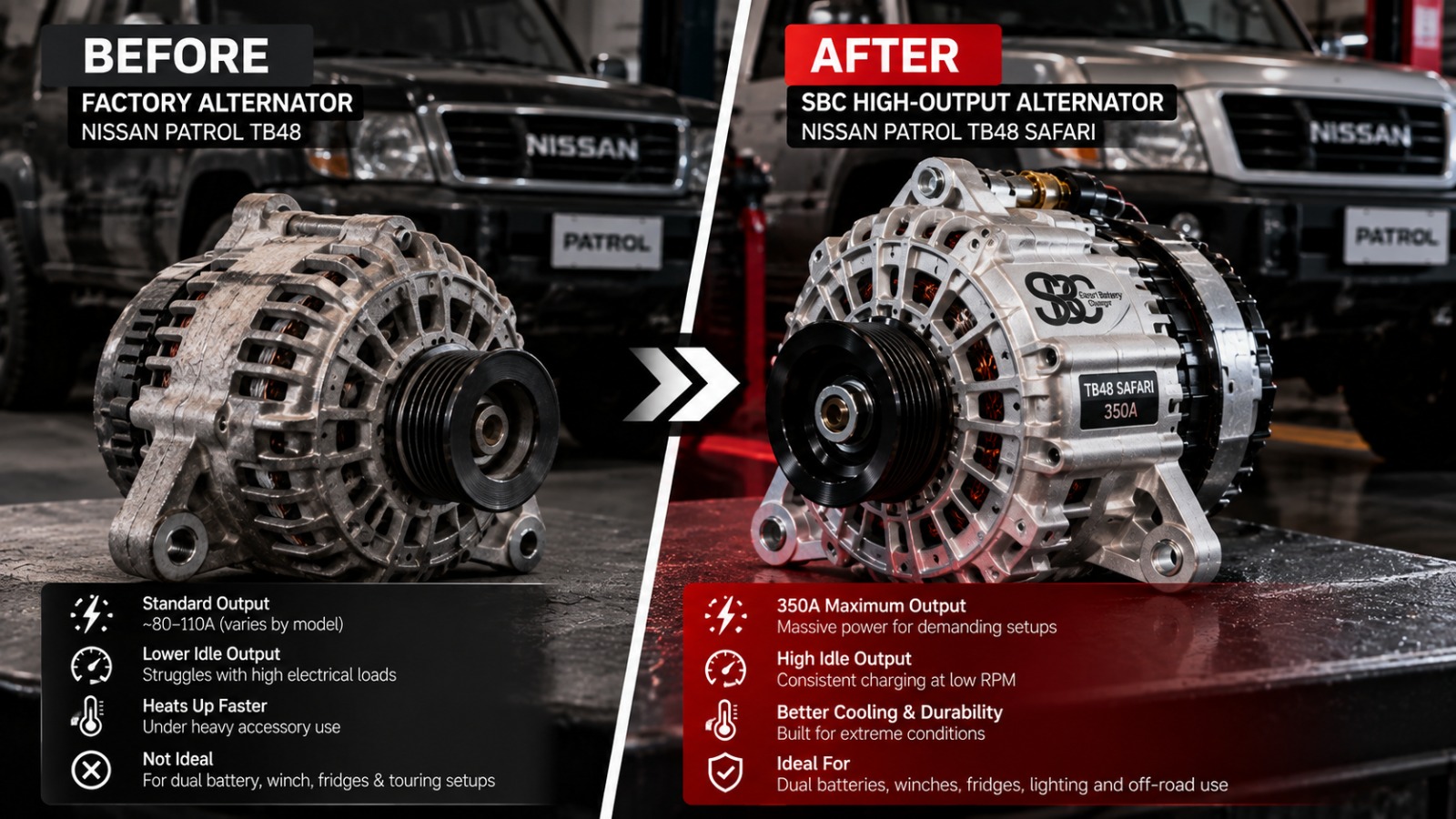
How to Choose a Nissan Patrol TB48 High Output Alternator
Choosing a Nissan Patrol TB48 high output alternator involves more than comparing maximum amp ratings. The right upgrade depends on how much electrical power your Patrol needs, how much current the alternator can produce at idle, and whether the charging cables and supporting components can handle the additional output. These factors become particularly important when your vehicle runs auxiliary batteries, recovery equipment, additional lighting, refrigeration or other electrical accessories.
The Nissan Patrol TB48DE is a popular platform for touring and off-road builds. However, adding electrical accessories can increase demand beyond what a standard charging system can comfortably supply under every operating condition. Understanding alternator output, installation requirements and the limits of your existing wiring helps you make a more informed upgrade decision.
1. Identify the Charging Problem Before Upgrading
Low voltage does not automatically mean that your alternator needs replacing. Before selecting a higher-output unit, establish when the problem occurs and which electrical loads are operating at the time.
Low Voltage at Idle
If voltage drops when the engine is idling with the air conditioning, cooling fans and auxiliary equipment switched on, the alternator may not be supplying enough current at that engine speed. Maximum alternator output is not necessarily available at idle, so a large headline amp rating does not tell the whole story.
Voltage Drops When Accessories Run Together
A winch, auxiliary battery charger, lighting system and other electrical accessories can place substantial demand on the charging system. If their combined current consumption approaches or exceeds available alternator output, the battery may have to supply part of the difference.
Charging Problems During Off-Road Driving
Slow trail driving can mean extended periods at low engine speed while cooling fans and other accessories remain active. In this situation, sustained low-speed output and heat management may matter more than the maximum rating advertised for an alternator.
Before purchasing a Nissan Patrol TB48 high output alternator, measure charging voltage at the battery under different operating conditions. Also inspect the drive belt, battery condition, terminals, grounds and charging cables. These checks help distinguish an alternator capacity problem from a wiring fault or another charging-system issue.
2. Compare TB48 Alternator Output at Idle and Maximum Speed
Alternator ratings should be assessed at the engine speeds and electrical loads relevant to your vehicle. Smart Battery Charger lists several Nissan TB48 alternator options with different maximum and idle-output ratings.
| Listed Alternator | Maximum Output | Normal Idle Output | High Idle Output |
|---|---|---|---|
| 250A TB48 | 251A | 186A | 200A |
| 270A TB48 | 273A | 200A | 215A |
| 390A TB48 | 392A | 220A | 235A |
These figures are the manufacturer’s listed ratings for the respective models. Actual output can vary with operating conditions, alternator temperature, engine speed, electrical demand and installation. Confirm the applicable specifications and fitment before ordering.
The comparison illustrates why idle output deserves attention. A vehicle that spends substantial time idling with several accessories operating may benefit more from a suitable alternator with stronger low-speed output than from choosing a model based on maximum amperage alone.
Review the available Smart Battery Charger alternator products and compare the specifications of the models suitable for your application.
3. Choose the Output That Matches Your Electrical Load
There is no single Nissan Patrol TB48 high output alternator rating that suits every vehicle. A lightly modified daily driver has different requirements from an expedition vehicle with an auxiliary battery bank and several high-draw accessories.
Daily Driving and Moderate Accessories
If your Patrol uses standard vehicle electronics with a limited number of additional accessories, start by calculating the total electrical load. A moderate-output upgrade may be sufficient if it provides the required current at the engine speeds you regularly use.
Touring and Dual-Battery Systems
A touring vehicle may run a refrigerator, camp lighting, communications equipment and an auxiliary battery charging system. Consider the current consumed by these devices alongside the vehicle’s normal electrical demand. Also determine how quickly the auxiliary battery needs to recover between stops.
High-Demand Off-Road Builds
Vehicles with electric recovery equipment, additional cooling fans and several electrical accessories need a more detailed load assessment. The relevant question is not simply whether an alternator has a higher rating, but whether it can supply the required current under the conditions in which the vehicle operates.
Remember that an alternator’s total output is shared across the vehicle’s electrical systems and charging loads. Do not assume that the full rated current is available exclusively to charge an auxiliary battery.
4. Check Fitment and Electrical Compatibility
A higher-output alternator must be compatible with the specific engine, mounting arrangement and charging system. Confirm the application before buying, especially if your Patrol has been modified or uses non-standard electrical components.
Smart Battery Charger lists a 250A Nissan TB48DE alternator with a stated maximum output of 251A, normal idle output of 186A and high idle output of 200A. Its product listing describes direct OEM bolt-in fitment. Verify that these details apply to your exact vehicle configuration.
Before installation, check the following:
- Engine and alternator application compatibility.
- Mounting points, belt alignment and pulley arrangement.
- Electrical connections, grounding and regulator compatibility.
- Charging cable size and the required overcurrent protection.
- Battery chemistry, charging requirements and any auxiliary charging equipment.
- Physical clearance and cooling airflow around the alternator.
Do not assume that an alternator is compatible simply because it is listed for the same engine family. Confirm the manufacturer’s fitment information and installation requirements before proceeding.
5. Upgrade the Wiring Alongside the Alternator
Installing a higher-output alternator without checking the charging cables can leave the electrical system with a bottleneck. The alternator may be capable of producing more current than the existing wiring can safely carry under the intended operating conditions.
Inspect the positive charging cable, battery connections, engine ground and chassis ground. Cable selection should account for expected current, cable length, insulation temperature rating, installation environment and acceptable voltage drop.
A suitable overcurrent protection device must also be selected and installed according to the wiring design and equipment requirements. Cable gauge and fuse ratings should not be chosen from alternator amperage alone.
After installation, measure voltage drop across the positive and negative sides of the charging circuit while the system is carrying a representative load. Excessive voltage drop can reduce charging performance and produce unwanted heat at cables, terminals or connections.
6. Manage Heat During Sustained Electrical Loads
High electrical output creates heat, and alternator performance can change as the unit warms up. Under demanding conditions, the alternator’s available continuous output may differ from a rating measured under other test conditions.
This is particularly relevant when a Nissan Patrol operates slowly off-road with several electrical accessories switched on. Engine speed, airflow, ambient temperature, mounting location and total electrical demand all influence operating conditions.
Keep the alternator’s cooling paths unobstructed and ensure the belt drive is correctly installed and maintained. Follow the manufacturer’s recommendations for continuous loading, temperature monitoring and regulator configuration.
If your build uses a large auxiliary battery bank, check that the charging system is compatible with the battery manufacturer’s charging requirements. A higher-output alternator does not, by itself, guarantee that every battery chemistry can be charged safely without appropriate regulation.
7. Investigate Other Causes of Low Charging Voltage
Replacing an alternator without diagnosing the original problem can lead to unnecessary expense. Several other faults can produce symptoms that resemble insufficient alternator output.
- Weak or damaged battery: A battery with an internal fault may not accept or retain charge correctly.
- Loose or corroded connections: Resistance at terminals and grounds can cause voltage loss.
- Worn or slipping belt: An incorrectly tensioned or damaged belt can affect alternator drive.
- Excessive electrical demand: The combined load may exceed the output available under the tested conditions.
- Charging-system faults: Wiring, regulator or other component issues may prevent normal operation.
Test the system before and after installation, using the same operating conditions where possible. This makes it easier to determine whether the upgrade has addressed the original issue.
Frequently Asked Questions
What should I look for in a Nissan Patrol TB48 high output alternator?
Compare maximum output, idle output, fitment, wiring requirements and suitability for your electrical loads. The best choice depends on how you use the vehicle and how much current your accessories require.
Why is alternator output at idle important?
At low engine speed, an alternator may produce less current than it does at higher speed. If the vehicle runs cooling fans, air conditioning and auxiliary charging equipment at idle, the available output at that speed becomes an important selection factor.
Will a higher-output alternator solve every low-voltage problem?
No. A higher-output alternator may help when electrical demand exceeds available generation, but it will not automatically resolve a weak battery, slipping belt, poor ground or damaged connection. Diagnose the charging system before replacing components.
Do I need to upgrade the charging cables?
The existing cables must be checked against the intended current and allowable voltage drop. A higher-output alternator may require larger conductors and appropriate overcurrent protection. The correct specifications depend on cable length, installation conditions and the electrical design.
Can I use a high-output alternator with an auxiliary battery?
Yes, provided the alternator, battery, charging equipment and wiring are compatible. Battery chemistry and charging requirements must be considered, and additional regulation or a DC-to-DC charger may be appropriate for some systems.
Does the maximum amp rating represent continuous output?
Not necessarily. Output depends on the test conditions and operating environment. Review the manufacturer’s ratings and ask for the relevant output information at the engine speeds and temperatures expected in your application.
Make an Informed TB48 Alternator Upgrade
Choosing a Nissan Patrol TB48 high output alternator starts with understanding your electrical demand and the conditions in which the vehicle operates. Maximum amperage matters, but idle output, fitment, wiring capacity and heat management are equally important when planning a dependable charging system.
Compare the specifications of the available TB48 models, inspect your existing charging circuit and verify compatibility before ordering. For product-specific information, review the 250A TB48 alternator and the manufacturer’s TB48 technical data sheet.
Matching the alternator to the real electrical load, rather than choosing by maximum amperage alone, provides a stronger basis for planning a charging-system upgrade.