
Land Cruiser High Output Alternator: Upgrade Your Charging System
Planning a land cruiser high output alternator upgrade? If your Toyota Land Cruiser runs auxiliary batteries, touring accessories, additional lighting, refrigeration or recovery equipment, choosing an alternator based only on its maximum amp rating can leave important questions unanswered. Idle output, engine compatibility, wiring capacity and your total electrical load all influence how well the charging system performs.
Smart Battery Charger (SBC) offers high-output alternator options for selected Toyota applications, including the 1VD-FTV platform. This guide helps you understand what to check before choosing an upgrade, how alternator output affects a dual-battery setup and which specifications deserve attention before you order.
VIEW 270A TOYOTA 1VD-FTV ALTERNATOR →
Best starting point: identify your engine, estimate your electrical demand and compare alternator output at idle before selecting a model.
Find the Right Land Cruiser Alternator Upgrade for Your Build
Not every Land Cruiser has the same charging requirements. A vehicle used primarily for daily driving has different needs from a touring build that powers a fridge and auxiliary battery, or an off-road vehicle running several electrical accessories at once.
Land Cruiser 200 with the 1VD-FTV V8 Diesel
The 1VD-FTV application is relevant to owners evaluating higher charging capacity for touring, auxiliary batteries and demanding electrical loads. SBC lists a 270A high-output alternator for this engine platform.
Land Cruiser with the 1GR-FE Petrol Engine
Owners of Land Cruiser models using the 1GR-FE petrol engine should confirm the exact vehicle generation, engine configuration and alternator mounting requirements before choosing an upgrade. Do not assume that a 1VD-FTV alternator fits a 1GR-FE application.
If your vehicle uses a different engine or has been modified, confirm compatibility with the supplier before ordering.
Why Consider a Land Cruiser High Output Alternator?
The purpose of a high-output alternator is to increase the charging system’s available electrical generation capacity. Whether an upgrade is worthwhile depends on the current alternator’s output, the vehicle’s electrical demand and the amount of power required for auxiliary equipment.
- Support additional electrical loads: account for lighting, refrigeration, communications equipment and other accessories.
- Improve charging capacity: select a suitable alternator when measured demand exceeds the available output of the existing unit.
- Plan a dual-battery system: assess alternator output alongside the auxiliary battery’s charging requirements and any DC-to-DC equipment.
- Evaluate low-speed performance: consider the current available at idle, particularly if the vehicle spends extended periods moving slowly off-road.
- Build a compatible electrical system: check cables, grounds, protection devices and battery compatibility as part of the upgrade.
A higher-rated alternator does not automatically solve every charging issue. Battery condition, belt drive, voltage drop, regulator compatibility and installation quality remain important.
COMPARE AVAILABLE ALTERNATORS →
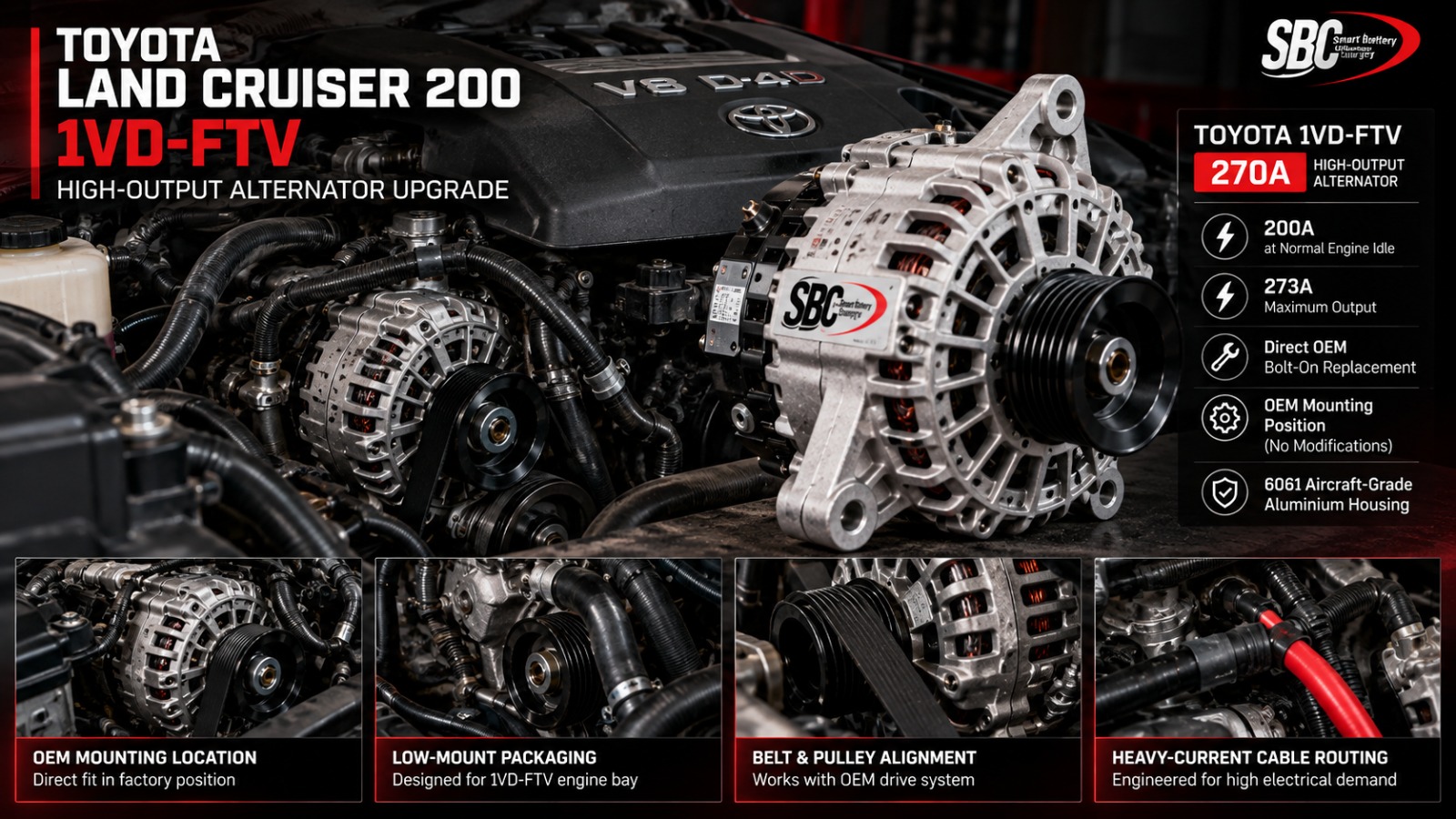
Featured Upgrade: Toyota 1VD-FTV 270A Alternator
For the Toyota 1VD-FTV application, SBC lists a 270A high-output alternator with the following published specifications.
SBC Toyota 1VD-FTV
270A High-Output Alternator
| Maximum listed output | 273A |
|---|---|
| Normal engine idle output | 200A |
| Mounting | Direct OEM bolt-on, as listed by SBC |
| Housing material | 6061 aluminium, as listed by SBC |
These are manufacturer-listed figures. Actual output depends on operating conditions, temperature, engine speed and electrical demand. Confirm the current product specifications and fitment for your vehicle before purchasing.
Idle Output: The Specification Many Owners Overlook
Maximum amperage describes only one part of alternator performance. An alternator generally produces different amounts of current at different speeds, and the available output can change as the unit heats up.
This matters when a Land Cruiser runs cooling fans, air conditioning and auxiliary electrical equipment while idling. If the combined demand is greater than the available alternator output, the battery may have to supply the shortfall.
When comparing a Land Cruiser high output alternator, ask for output figures at the relevant operating speeds rather than relying exclusively on the largest number in the product name.
Build a Dual-Battery System That Works as a Complete Setup
A high-output alternator can be part of a dual-battery charging system, but it is not the only component that determines charging performance. The alternator, starting battery, auxiliary battery, cables and charging equipment need to work together.
1. Calculate the Electrical Load
List the vehicle’s standard electrical demand and the additional equipment installed. Include refrigeration, lighting, fans, communications equipment, inverters and battery charging loads where applicable. Consider which devices operate simultaneously.
2. Match the Charging Method to the Battery
Different auxiliary battery chemistries have different charging requirements. Confirm whether your system needs a compatible DC-to-DC charger, an appropriate regulator or other charging equipment. Do not assume that increasing alternator output alone establishes a suitable charging profile.
3. Check Cable Size and Voltage Drop
The charging cables must safely carry the intended current. Cable length, conductor material, insulation rating, installation temperature and acceptable voltage drop all affect cable selection. Fit suitable overcurrent protection according to the electrical design.
4. Verify Grounds and Connections
Inspect the alternator ground path, engine-to-chassis connection, battery terminals and positive charging cable. Poor connections can create resistance, heat and voltage loss, limiting the benefit of a higher-output alternator.
5. Plan for Heat and Continuous Demand
Off-road driving may involve low engine speed, high accessory demand and elevated under-bonnet temperatures. Check the alternator’s operating guidance and ensure its cooling paths, belt drive and surrounding installation meet the manufacturer’s requirements.
For a more complete system plan, explore the SBC alternator range and verify which products and charging components are suitable for your vehicle.
Fitment Checklist Before You Buy
Before ordering a Land Cruiser high output alternator, use this checklist to reduce the risk of choosing an incompatible unit.
- Confirm the Land Cruiser model, model year and engine code.
- Verify the alternator’s mounting arrangement and pulley compatibility.
- Confirm the listed maximum output and output at relevant engine speeds.
- Check electrical connections and regulator compatibility.
- Assess charging cable capacity, grounds and overcurrent protection.
- Confirm compatibility with the starting battery and auxiliary charging setup.
- Review the manufacturer’s installation instructions and fitment notes.
Vehicle modifications, engine swaps and differences between model generations can affect fitment. Confirm the exact application with the supplier instead of relying on the engine name alone.
CHECK THE 1VD-FTV 270A OPTION →
Frequently Asked Questions
What does a Land Cruiser high output alternator do?
It provides increased electrical generation capacity compared with a lower-output unit, subject to the specific model’s performance. The additional capacity may help support accessories and auxiliary charging loads when the existing alternator cannot meet the demand.
Which Land Cruiser engines are covered by this guide?
This guide discusses the 1VD-FTV diesel and 1GR-FE petrol platforms. They require separate fitment checks. The featured 270A SBC product is listed for the Toyota 1VD-FTV application; do not assume that it fits a 1GR-FE vehicle.
How much output does the SBC 1VD-FTV 270A alternator provide at idle?
SBC lists 200A at normal engine idle and a maximum output of 273A for this product. These are published specifications, not a guarantee of identical output under every temperature, engine speed or electrical load.
Will a high-output alternator fully charge my auxiliary battery?
That depends on the battery chemistry, charging profile, battery state of charge, electrical loads and charging equipment. A suitable regulator or DC-to-DC charger may be needed to meet the battery manufacturer’s requirements.
Do I need to upgrade the Land Cruiser’s wiring?
You should have the existing positive cable, grounds, connections and protection devices assessed against the intended current and voltage-drop limits. A higher-output alternator may require changes to the charging circuit.
Is maximum amperage enough to compare alternators?
No. Consider output at idle and other relevant speeds, fitment, thermal operating conditions, wiring requirements and the total electrical demand of the vehicle.
Choose Your Land Cruiser Alternator Upgrade
A well-planned Land Cruiser charging upgrade begins with the correct engine application and a realistic electrical load assessment. Idle output, cable capacity, battery compatibility and installation requirements all matter alongside maximum amperage.
If your vehicle uses the Toyota 1VD-FTV engine, review the specifications of the SBC 270A option and confirm its suitability for your exact configuration. For other Land Cruiser engines, compare the available products and verify fitment before ordering.