
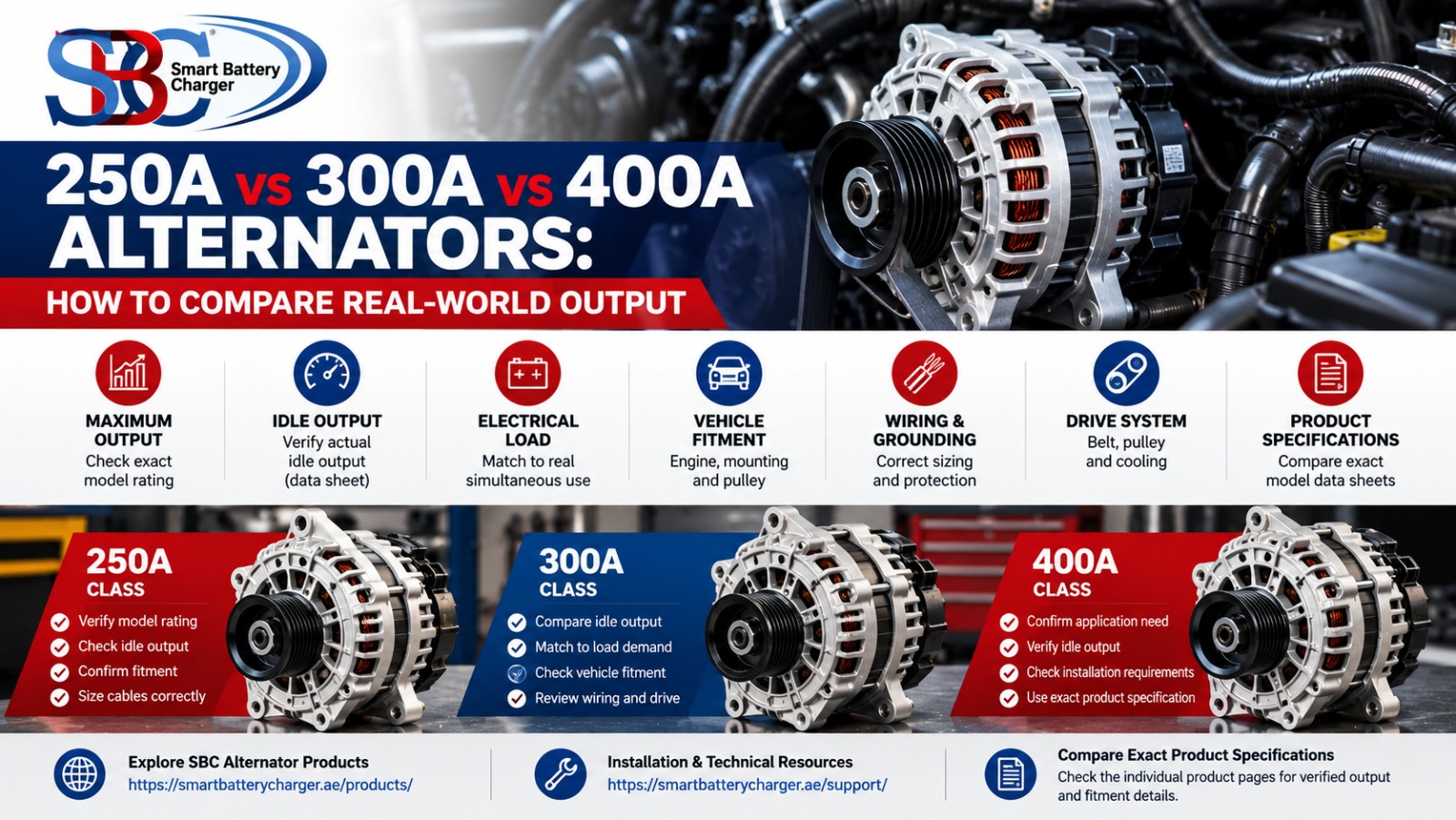
Choosing between a 250 amp vs 300 amp vs 400 amp alternator requires more than comparing the maximum amperage printed in a product title. The right option depends on electrical demand, system voltage, output at the engine speeds where equipment operates, vehicle fitment, and the wiring and drive system.
This comparison explains how to assess alternator output classes without assuming that the highest rating is automatically the best choice. Exact specifications must be checked for the selected product because idle output, regulation and vehicle fitment vary between models.
Quick Answer: Which Alternator Rating Should You Choose?
- 250A class: Consider it only if verified output meets the actual electrical load and application requirements.
- 300A class: Check its exact maximum and idle output, voltage, fitment and regulation requirements.
- 400A class: Confirm that the application needs its available capacity and that the vehicle, cabling and drive system support the installation.
These are selection principles, not universal performance claims. Compare the exact product specifications before choosing an alternator.
What Does an Alternator Amp Rating Mean?
Amperage measures electrical current. An alternator’s stated maximum output is a product specification under defined operating conditions. It is not a guarantee that the alternator will deliver that current at every engine speed or temperature.
Idle output is a separate specification. It can be particularly important when high electrical demand occurs at low engine speed, such as when a vehicle operates auxiliary equipment while stationary.
Compare the manufacturer’s maximum output, idle output, system voltage and test conditions. A headline amp number alone is not enough to determine whether an alternator suits your application.
250 Amp vs 300 Amp vs 400 Amp Alternator: Comparison Framework
When comparing a 250 amp vs 300 amp vs 400 amp alternator, assess each unit against the same criteria. Do not assume that every alternator in a given output class delivers the same current at idle or fits the same vehicle.
| Factor | 250A class | 300A class | 400A class |
|---|---|---|---|
| Maximum output | Verify exact model rating | Verify exact model rating | Verify exact model rating |
| Idle output | Check separately | Check separately | Check separately |
| Electrical load | Must meet validated load budget | Must meet validated load budget | Must meet validated load budget |
| Vehicle fitment | Engine and mounting specific | Engine and mounting specific | Engine and mounting specific |
| Cabling and grounding | Size for the actual installation | Size for the actual installation | Size for the actual installation |
| Best selection method | Verify specs and application | Verify specs and application | Verify specs and application |
This table intentionally does not assign universal idle-output figures to each class. Actual output varies by alternator model, pulley ratio, engine speed, regulation and installation conditions.
Why Idle Output Can Matter More Than the Headline Rating
Consider a vehicle that operates lighting, pumps or other equipment while stationary. If those loads exceed the alternator’s available output at idle, the battery may supply the difference. A higher maximum rating does not automatically solve the problem if idle output remains insufficient for the use case.
Look for product data that states idle output under a defined condition. Compare the stated output with your actual simultaneous electrical demand, while also accounting for battery charging and other vehicle loads.
Two SBC Product-Specific Examples
The SBC-DGM6.2-300 product page lists a 24-volt secondary system, 200 amps at normal idle and 300 amps maximum.
The SBC-DGM6.2V2-400 product page lists a different 24-volt secondary configuration with 166 amps at idle and 400 amps maximum.
These are specific product configurations, not universal results for every 300A and 400A alternator. They illustrate why maximum rating and idle output must be compared separately. Verify the figures and application details against the current product documentation before purchasing.
How to Decide Which Output Class Fits
- Create a load list. Record equipment current or power requirements and identify realistic simultaneous-use conditions.
- Confirm system voltage. Establish whether the installation is a replacement alternator or an additional charging system.
- Compare output data. Review idle output, maximum output and the conditions under which each figure is specified.
- Confirm vehicle fitment. Check engine, mounting bracket, pulley, rotation and regulator compatibility.
- Check wiring requirements. Verify positive cable and ground sizing, circuit protection and allowable voltage drop.
- Review mechanical requirements. Confirm belt drive, mounting strength, cooling and clearance.
- Obtain technical confirmation. Ask the supplier or qualified installer to validate unusual operating conditions before purchase.
Installation Factors That Affect Real-World Performance
The alternator is only one part of the charging system. Undersized cables can create voltage drop and heat; poor ground connections can restrict current flow; belt slip can limit mechanical drive; and incompatible control wiring can prevent the system from operating as intended.
Positive and negative cables may need upgrading when replacing an original alternator with a high-output model. Cable selection depends on current, length, allowable voltage drop, insulation rating and installation conditions.
Use the relevant SBC wire-sizing and installation resources rather than selecting cable by appearance. Confirm the actual requirements for the selected product and system voltage.
For general charging-system inspection principles, consult the Bosch Charging Systems technical reference. This external reference provides general charging-system information; use the vehicle and alternator manufacturer’s documentation for exact product fitment and installation requirements.
When a Higher Alternator Rating Is Not the Answer
A larger alternator does not automatically fix a damaged battery, parasitic drain, starter fault, poor connection or incompatible charging control. Diagnose the existing system before deciding that more alternator capacity is required.
The goal is sufficient, reliable output for the intended application, not the largest number in a product title. Selecting a higher-rated unit without checking fitment and electrical requirements can introduce unnecessary installation work or compatibility problems.
For vehicle-specific options, review the SBC product catalogue and compare the exact product specifications. Where output figures or compatibility are unclear, obtain confirmation before ordering.
Frequently Asked Questions
Is a 400A alternator always better than a 250A alternator?
No. The right choice depends on electrical load, idle output, vehicle fitment, system voltage and installation requirements. A higher maximum rating is not automatically more suitable.
What is the difference between maximum output and idle output?
Maximum output is the stated output under specified operating conditions. Idle output is the output available at a defined idle condition. They are separate specifications and should be compared independently.
Can I compare alternators by amperage alone?
No. Compare system voltage, idle output, fitment, regulation, pulley drive, cable requirements and installation conditions in addition to maximum amperage.
Will a 300A alternator deliver 300 amps at idle?
Not necessarily. The maximum rating and idle output are different specifications. Check the exact product data sheet and its stated test conditions.
Do higher-output alternators need larger cables?
Cable and ground capacity must be suitable for the expected current, cable length and allowable voltage drop. Follow the specific installation guidance and applicable wire-sizing requirements.
Should I replace a 250A alternator with a 400A unit if my battery keeps going flat?
Not before diagnosis. The cause may be battery condition, wiring, charging controls, parasitic drain or belt drive rather than insufficient alternator capacity.
Compare Alternators for Your Application
Before selecting a 250A, 300A or 400A alternator, confirm your electrical load, required idle output, system voltage, vehicle fitment and wiring requirements.
Explore the SBC product catalogue and review SBC technical support resources before choosing a product. Verify exact specifications and compatibility before ordering.