
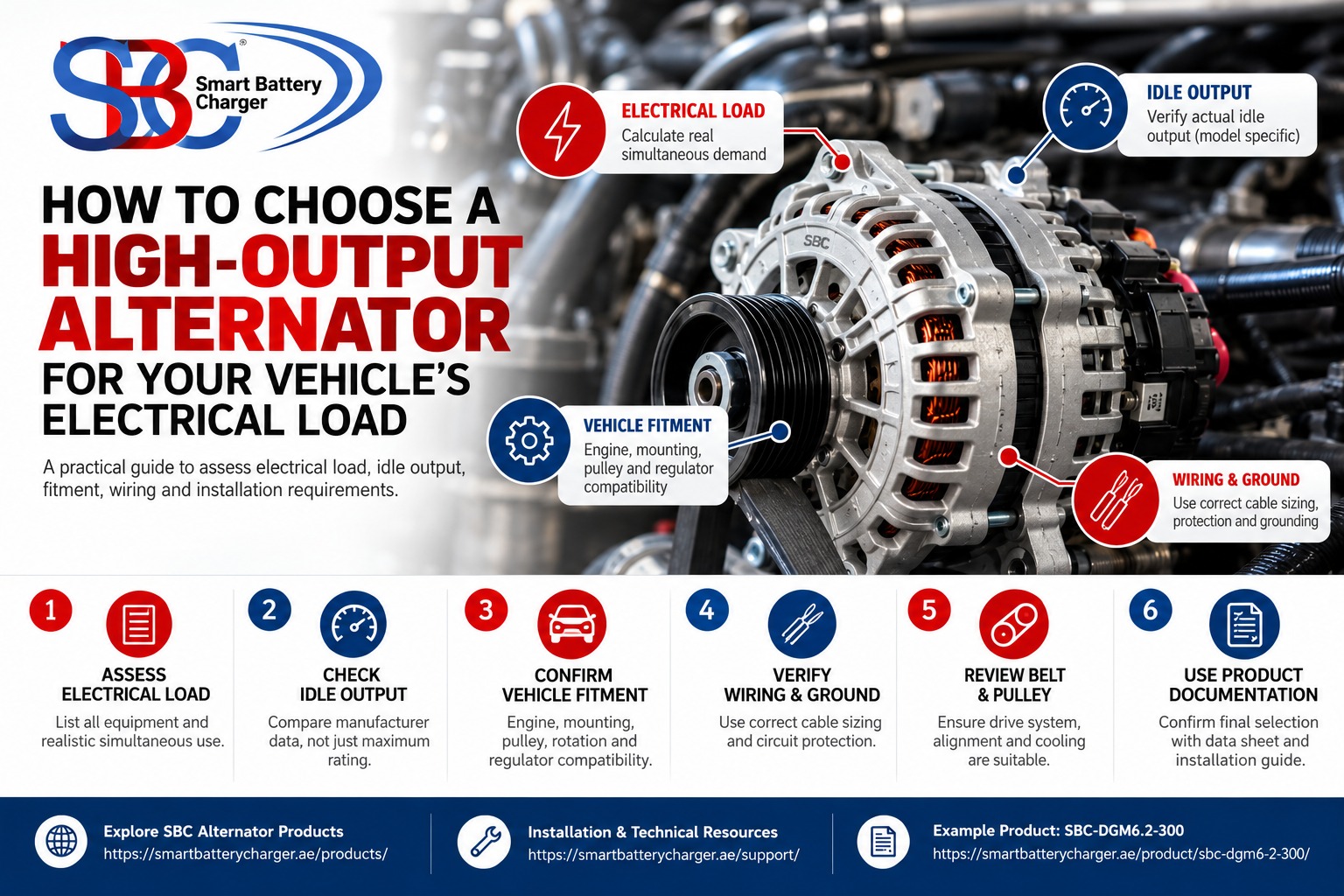
High output alternator selection should begin with your vehicle’s electrical demand, not the largest amperage number available. The right unit must fit the engine and mounting arrangement, work with the vehicle’s charging controls, and provide suitable output at the engine speeds where the electrical load is used.
Before choosing an upgrade, estimate the electrical load, compare idle output with maximum rated output, and confirm the vehicle’s voltage, fitment, wiring and regulation requirements. These checks help you select a product for the actual application instead of relying on a headline amperage rating.
High Output Alternator Selection: Quick Checklist
- Calculate the electrical loads that operate simultaneously.
- Compare idle output and maximum rated output separately.
- Confirm vehicle, engine, mounting and pulley compatibility.
- Verify system voltage and regulator or control requirements.
- Check cable capacity, grounding, circuit protection and voltage drop.
- Review the exact product specifications before ordering.
Start with your application requirements, then review available SBC alternator options and verify fitment before purchasing.
1. Calculate the Vehicle’s Electrical Load
List the equipment that may operate at the same time: factory vehicle systems, lighting, winches or pumps where applicable, audio amplifiers, auxiliary equipment and any additional electrical system. Record each device’s operating current or power requirement from the manufacturer’s documentation.
If a device’s power is stated in watts, estimate current with this formula:
Current (A) = Power (W) ÷ Voltage (V)
For example, a 600-watt load operating at a nominal 12 volts would draw an estimated 50 amps using this simplified calculation. Actual current can differ because of conversion efficiency, voltage variation, start-up demand and operating conditions.
Do not simply add every device’s maximum rating and assume all loads operate simultaneously. Identify realistic simultaneous-use conditions and allow for battery charging and expected variation. A qualified installer should validate the final load budget.
2. High Output Alternator Selection: Why Idle Output Matters
An alternator’s maximum rated output is not necessarily available at engine idle. Output varies with alternator speed, pulley ratio, temperature, regulator behaviour and the alternator design.
This distinction matters when a vehicle operates heavy electrical equipment while stationary. If the main load is used at idle, verified idle-output data may be more useful than the maximum rating alone.
Compare manufacturer-stated idle output and rated maximum output as separate figures. Check the conditions under which each figure was measured, and compare the available output with the real simultaneous load and battery-charging requirements.
A product-specific SBC example
The SBC-DGM6.2-300 product page lists 200 amps at idle and 300 amps maximum for its specified 24-volt secondary system. These figures apply to that product and application; they should not be generalised to every alternator in the same nominal class.
Confirm the current product specifications and intended application before using these figures to make a purchase decision.
3. Confirm Vehicle Fitment and System Voltage
A high-output alternator must fit mechanically and operate correctly with the vehicle’s electrical architecture. Confirm the following details before ordering:
- Vehicle make, model year and engine code.
- Mounting brackets, mounting position and available clearance.
- Belt arrangement, pulley dimensions and alignment.
- Alternator rotation and relevant drive requirements.
- Connector, regulator and vehicle-control compatibility.
- Nominal system voltage and intended charging-system configuration.
- Grounding arrangement and required installation hardware.
Some installations add a separate electrical system while retaining the original vehicle system. Others replace the original alternator. The correct architecture depends on the vehicle, loads and equipment.
Do not assume that a 24-volt alternator can directly replace a 12-volt unit or that two systems can share wiring without a documented design. Confirm the intended architecture and product compatibility before installation.
4. Check Cable, Ground and Circuit Protection Requirements
Higher current can require larger positive and negative cables, appropriate circuit protection, secure terminations and suitable routing. Cable selection depends on current, cable length, allowable voltage drop, insulation rating, temperature and installation conditions.
Ground connections are equally important. A poor ground path or undersized cable can cause excessive voltage drop and reduce system performance even when the alternator itself is correctly selected.
Use the relevant product installation instructions and SBC 12-volt wire-sizing chart as a reference for applicable 12V installations. Do not use a 12V chart as the sole sizing authority for a different system voltage or installation configuration.
Additional installation guides and technical resources are available through SBC Support.
5. Review Belt, Pulley and Mechanical Requirements
Electrical capacity alone does not guarantee a successful installation. Belt capacity, pulley alignment, tension, bracket strength, cooling and mechanical clearance also matter.
A correctly rated alternator may still underperform or create mechanical problems if the drive belt slips, the mounting is incorrect or the installation introduces excessive electrical resistance. Confirm these requirements using the exact product instructions and vehicle application data.
6. Verify Regulation and Charging-System Compatibility
The alternator must work with the intended regulator and vehicle charging controls. Depending on the application, the system may use conventional regulation or electronically controlled charging.
Before choosing a replacement or upgrade, confirm connector compatibility, regulator requirements, sensing and control arrangements, and any vehicle-specific installation procedures. Physical fit alone does not establish electrical compatibility.
For general charging-system inspection principles, consult the Bosch Charging Systems technical reference. This is a general technical resource, not a substitute for vehicle-specific fitment and installation instructions.
7. Avoid These Common Selection Mistakes
- Choosing by maximum amperage alone: Compare actual load demand and output at relevant operating speeds.
- Assuming full output is available at idle: Request manufacturer-stated idle-output data where it matters.
- Ignoring system voltage: Verify that the product matches the intended electrical architecture.
- Overlooking cable and ground capacity: Check current, length, voltage drop and installation requirements.
- Ignoring mechanical fitment: Confirm brackets, pulley, belt and clearance.
- Assuming a new alternator fixes every fault: Diagnose battery, wiring, starter and parasitic-drain problems separately.
8. Final High Output Alternator Selection Checklist
- Document the electrical loads and identify which are used simultaneously.
- Confirm nominal system voltage and the intended charging-system architecture.
- Identify the exact vehicle, engine, model year and mounting configuration.
- Compare idle output as well as maximum rated output.
- Verify regulator and vehicle-control compatibility.
- Check cable sizing, ground paths, circuit protection and expected voltage drop.
- Confirm belt, pulley, mounting and cooling requirements.
- Use the exact product data sheet and installation instructions to validate the final configuration.
Match the Alternator to Your Application
The right high-output alternator is the unit that meets the actual electrical requirement and is compatible with the vehicle and installation. If the load is concentrated at idle, prioritise verified idle-output data. If the application has unusual voltage, mounting or control requirements, obtain product-specific technical confirmation before ordering.
Review the SBC product catalogue for available alternator applications and the SBC technical support resources for installation information. Confirm exact fitment and configuration before making a purchase decision.
Frequently Asked Questions
Is a higher-amp alternator always better?
No. The right unit depends on electrical demand, vehicle fitment, idle output, system voltage, regulation and installation requirements.
Why is alternator idle output important?
Some vehicles operate significant electrical loads while stationary. Maximum rated output may not be available at idle, so compare manufacturer-stated idle output when the application requires it.
How do I estimate alternator amperage requirements?
List the loads that operate simultaneously and use manufacturer current figures. For watt-rated devices, estimate current by dividing power in watts by system voltage, then validate the design against actual operating conditions.
Do I need larger cables for a high-output alternator?
The positive cables and ground paths must be suitable for the expected current, cable length and allowable voltage drop. Follow the applicable wire-sizing guidance and product installation instructions.
Can I install a 24-volt alternator in a 12-volt vehicle?
Not as a direct substitution unless the electrical system has been specifically designed for that configuration. Verify system voltage, architecture and product compatibility first.
Will a high-output alternator fix a discharged battery?
Only if inadequate charging capacity is the actual cause and the replacement is correctly selected and installed. Battery health, wiring faults and parasitic drain should also be investigated.
Need Help Selecting an Alternator?
Confirm your vehicle application, electrical load, idle-output requirement, system voltage and installation constraints before selecting an upgrade.
Explore SBC alternator products and consult SBC Support for relevant technical resources. Verify exact fitment and specifications before ordering.