
DC-to-DC Charger vs High-Output Alternator: Which Setup Is Right for You?
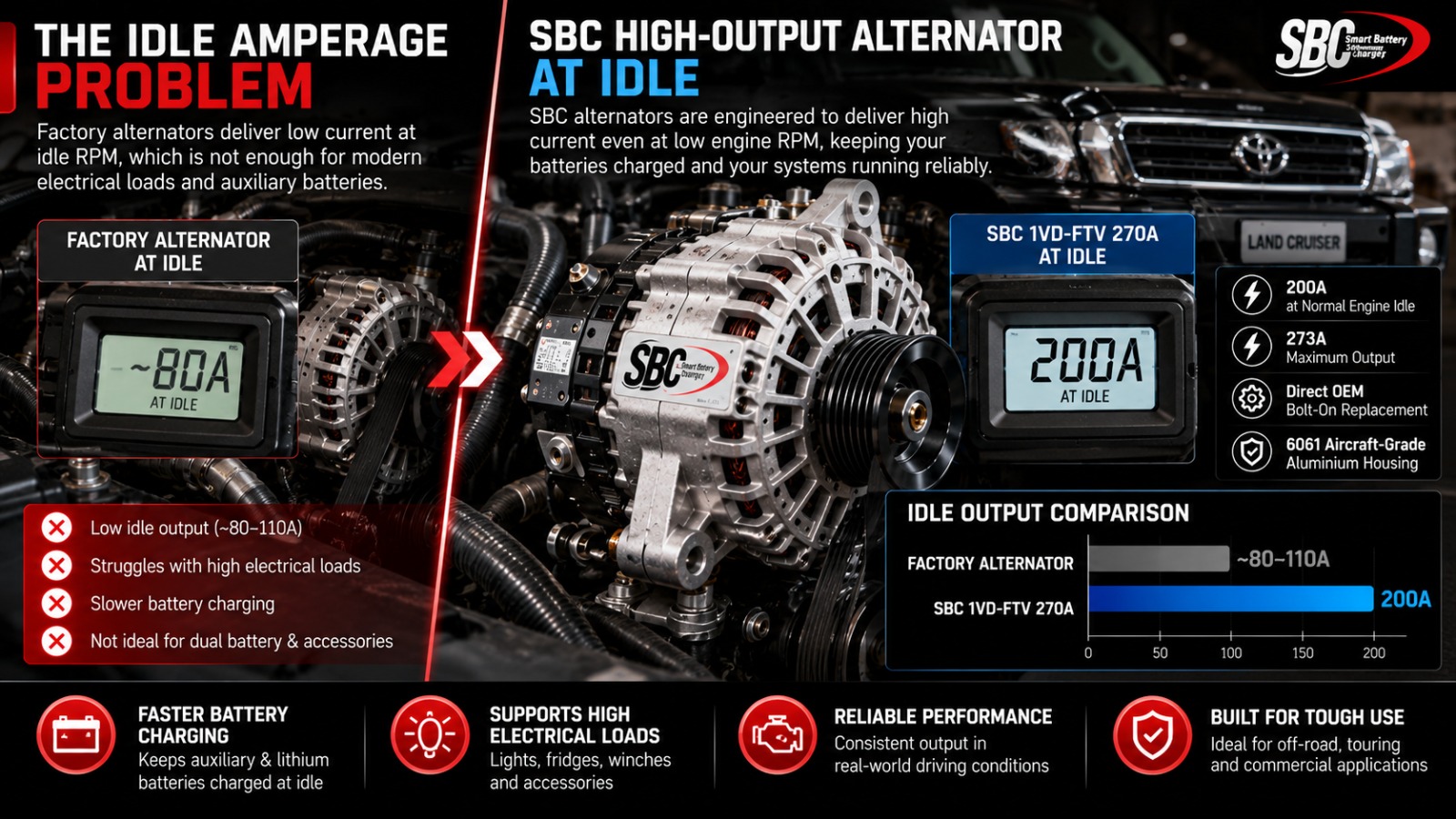
Choosing between a smart alternator dc to dc charger vs high output alternator setup depends on your auxiliary battery capacity, daily driving time and total electrical demand. A DC-to-DC charger can be a practical solution for a modest battery bank, while a high-output alternator may suit a vehicle that needs to supply substantial electrical loads and recharge a large auxiliary battery during shorter drives. Some builds benefit from combining both.
If your 4×4 powers a refrigerator, camp lighting, communications equipment or other accessories, the right charging architecture can make a meaningful difference to how you plan and use your electrical system. The objective is not simply to buy the highest-rated component. It is to match generation capacity, charging current and battery requirements to the way you actually use your vehicle.
EXPLORE HIGH-OUTPUT ALTERNATORS →
Quick Comparison: DC-to-DC Charger vs High-Output Alternator
Use this comparison as a starting point. The final choice depends on the vehicle’s available alternator output, battery specifications, driving conditions and accessory loads.
| Consideration | DC-to-DC Charger | High-Output Alternator |
|---|---|---|
| Main role | Controls and converts charging power delivered to an auxiliary battery. | Increases the vehicle’s electrical generation capacity. |
| Charging current | Limited by the charger’s rated output and operating conditions. | Depends on alternator output at the operating speed and temperature. |
| Smaller battery systems | Can be suitable where charging demand is modest. | May be unnecessary if the existing system already meets demand. |
| Large electrical loads | Does not increase the vehicle alternator’s generation capacity. | Can provide additional generation capacity when correctly sized. |
| Smart alternator compatibility | A compatible charger can manage variable input voltage. | Requires an application-compatible alternator and charging strategy. |
| Best selection factor | Battery charging requirements and desired charging current. | Total electrical demand and available output at relevant engine speeds. |
Quick verdict: A DC-to-DC charger manages the power delivered to the auxiliary battery. A high-output alternator increases the electrical generation capacity available from the engine. They perform different functions and can be used together.
COMPARE SBC ALTERNATOR OPTIONS →
Option 1: When a DC-to-DC Charger Makes Sense
A DC-to-DC charger takes electrical power from the vehicle’s charging circuit and conditions it for the auxiliary battery. Depending on the model, it can regulate charging voltage and current to suit supported battery chemistries.
Because the charger’s output is limited by its rating, it can also limit how much current the auxiliary charging system draws under normal operation. This can be useful when the vehicle has a suitable factory alternator and the auxiliary battery’s charging demand is relatively modest.
Consider a DC-to-DC Charger If You:
- Run a relatively small auxiliary battery bank.
- Drive long enough to replace the energy used between trips.
- Need controlled charging for a supported AGM or lithium battery.
- Have verified that the factory alternator has enough spare capacity.
- Want to manage auxiliary battery charging without increasing alternator output.
A DC-to-DC charger does not create extra electricity. If the vehicle’s normal electrical demand and charger input exceed the alternator’s available output, the battery may supply the shortfall. That is why the overall load calculation matters even when a charger is installed.
What About Smart Alternators?
Some modern vehicles vary their charging voltage in response to driving conditions and energy-management strategies. A charging device designed to accept the vehicle’s input-voltage range can help manage this type of system.
Check the charger’s documented input-voltage range, ignition-signal requirements, current draw and supported battery profiles. Compatibility should be confirmed for the exact vehicle rather than assumed from the phrase “smart alternator compatible.”
Option 2: When a High-Output Alternator Makes Sense
A high-output alternator is designed to provide greater electrical generation capacity than a lower-output unit. It may be appropriate when the vehicle’s standard electrical loads and auxiliary equipment place substantial demand on the charging system.
For touring and expedition vehicles, the key question is whether the alternator can supply the vehicle’s electrical loads while also providing the required current for auxiliary charging. The answer depends on actual output at the engine speed and temperature encountered during use.
Consider a High-Output Alternator If You:
- Operate several high-demand accessories at the same time.
- Need more charging capacity than the existing alternator can provide.
- Use a large auxiliary battery bank and have limited driving time between stops.
- Spend significant time at low engine speeds with electrical loads operating.
- Need a system designed around a higher continuous electrical demand.
Maximum amperage alone is not enough to select an alternator. Check its output at relevant engine speeds, operating-temperature limitations, mounting compatibility, belt drive and electrical connection requirements.
FIND A HIGH-OUTPUT ALTERNATOR →
Calculate the Charging Time Your Battery Bank May Need
Battery capacity and charging current provide a useful first estimate of how long recharging may take. For a simple estimate, divide the energy deficit in ampere-hours by the effective charging current.
Estimated charging time (hours) = Energy deficit (Ah) ÷ Effective charging current (A)
Real charging time can be longer because of conversion losses, changing current acceptance, battery charging stages, electrical loads operating during travel and alternator output limits. The figures below are illustrative calculations, not guaranteed charging times.
| Battery Bank | Energy to Replace at 80% Replenishment | 25A Effective Current | 50A Effective Current | 180A Effective Current |
|---|---|---|---|---|
| 100Ah | 80Ah | 3.2 hours | 1.6 hours | 27 minutes |
| 200Ah | 160Ah | 6.4 hours | 3.2 hours | 53 minutes |
| 300Ah | 240Ah | 9.6 hours | 4.8 hours | 80 minutes |
| 400Ah | 320Ah | 12.8 hours | 6.4 hours | 107 minutes |
These estimates assume the listed current is delivered continuously to the battery. In practice, the effective current may be lower, and the vehicle may not have enough spare alternator output to sustain a high charging rate.
A 300Ah battery bank needing 240Ah of replenishment illustrates the difference between a modest and a high effective charging current. At 50A, the basic calculation is 4.8 hours. At 180A, it is about 80 minutes. Neither figure should be treated as a guaranteed drive time without checking the complete system.
Why the Electrical Load Budget Matters
An alternator supplies the vehicle’s electrical systems as well as any auxiliary charging equipment. Before selecting a charger or upgrading an alternator, add up the expected current demand.
Consider this illustrative load profile for a modified off-road vehicle:
| Electrical Load | Example Current |
|---|---|
| Vehicle electronics and ignition | 25A |
| Electric radiator fans | 45A |
| Cabin blower and condenser fan | 22A |
| Auxiliary lights and radios | 15A |
| Example accessory total | 107A |
If a DC-to-DC charger delivers 50A to an auxiliary battery at 90% conversion efficiency, its input demand would be approximately 55.6A under that simplified assumption.
Combined example demand would therefore be about 162.6A before accounting for any additional loads or variations. A nominal 120A alternator cannot be assumed to supply that demand continuously. The actual available output at the operating speed and temperature must be checked.
This example is not a specification for every vehicle. Measure or verify the loads on your own build before deciding whether a charger, alternator upgrade or combination of both is appropriate.
Will Heat Affect Charging Performance?
Both charging equipment and alternators operate within thermal limits. Under-bonnet temperatures, low-speed airflow, mounting location and continuous electrical demand can affect how a system performs.
Some DC-to-DC chargers reduce output when their internal temperature rises. Alternator output can also be limited by operating temperature and engine speed. The amount of any reduction depends on the specific product, so avoid applying one universal derating percentage to all chargers or alternators.
For hot-weather and low-speed off-road use, check the manufacturer’s temperature and installation specifications. Ensure that the charging equipment has suitable ventilation and is mounted in an environment allowed by its manufacturer.
How Smart Alternator Systems Change the Decision
A smart alternator may vary charging voltage rather than maintaining a constant output voltage under all driving conditions. That behaviour can affect the charging method used for an auxiliary battery.
A compatible DC-to-DC charger can manage an input voltage that varies within its documented limits. A high-output alternator upgrade, however, must be compatible with the vehicle’s electrical architecture and control strategy. It should not be assumed that any replacement alternator will communicate correctly with the vehicle electronics or provide a suitable charging profile for every battery.
Before choosing a system, confirm:
- Whether the vehicle uses a variable-voltage charging system.
- The input-voltage and current requirements of the proposed charger.
- Alternator fitment and regulator compatibility.
- The auxiliary battery manufacturer’s charging requirements.
- Whether additional monitoring or protection components are required.
Which Charging Setup Fits Your Vehicle?
Use these profiles as a starting point for comparing the available approaches. Final selection still depends on measured loads, battery requirements and product compatibility.
Setup A: Weekend Camper
Typical needs: a modest auxiliary battery, a fridge and camp lighting, with regular longer drives.
Starting point: a compatible DC-to-DC charger, provided the factory alternator has enough spare capacity.
Setup B: Touring 4×4
Typical needs: a larger battery bank, refrigeration, lights, communications equipment and mixed driving conditions.
Starting point: calculate total demand first. A hybrid system with a suitable alternator and DC-to-DC charger may be worth evaluating.
Setup C: Heavy Expedition Vehicle
Typical needs: substantial auxiliary storage, multiple electrical accessories and shorter drives between camps.
Starting point: assess whether a high-output alternator and an appropriate regulation strategy can meet the charging requirement. Verify continuous output, battery compatibility and protection requirements.
Setup D: Separate 24V or 48V Auxiliary System
Typical needs: a dedicated higher-voltage electrical architecture for specialised equipment.
Starting point: evaluate the complete system design, including alternator voltage, battery configuration, grounding, isolation and compatible charging equipment. Do not connect different voltage systems without a suitable design.
EXPLORE SBC HIGH-OUTPUT ALTERNATORS →
Can a High-Output Alternator Replace a DC-to-DC Charger?
Not in every setup. A high-output alternator increases available generation capacity, but the auxiliary battery still needs a suitable charging voltage and current profile. Depending on the alternator, battery chemistry and regulator configuration, additional charging or protection equipment may be required.
For lithium systems in particular, verify compatibility with the battery manufacturer’s charging specifications and battery management system. A direct connection should not be assumed safe solely because the alternator has a high current rating.
Frequently Asked Questions
Is a DC-to-DC charger better than a high-output alternator?
Neither is universally better. A DC-to-DC charger controls the power delivered to an auxiliary battery, while a high-output alternator increases generation capacity. Choose according to the vehicle’s electrical demand, battery size and driving pattern.
Can I use a DC-to-DC charger with my factory alternator?
Yes, if the charger is compatible with the vehicle and the factory alternator has sufficient capacity for both normal vehicle loads and the charger’s input demand. Check output at relevant engine speeds rather than relying only on the alternator’s nominal rating.
Will a high-output alternator charge a 300Ah lithium battery faster?
It may allow a higher charging current if the alternator, regulator, wiring and battery all support it. Actual charging time also depends on the energy deficit, battery acceptance rate, operating conditions and loads running at the same time.
Can I run two 50A DC-to-DC chargers?
Two chargers may provide a combined nominal output of 100A if the products support that configuration. Their combined input demand can be greater than 100A, and the vehicle alternator must have enough spare capacity. Verify the manufacturer’s instructions for parallel operation and system protection.
Does hot weather reduce charging performance?
It can. Some chargers reduce current to protect internal components, and alternator output may also change with temperature and engine speed. Check the thermal limits and installation guidance for the actual products in your system.
What should I check before upgrading?
Confirm battery capacity and chemistry, total electrical demand, alternator output at operating speed, cable capacity, voltage drop, grounding, regulator compatibility and product fitment. These checks help determine whether you need a charger, an alternator upgrade or a combined system.
Make the Right Charging-System Decision
The choice between a DC-to-DC charger and a high-output alternator should begin with your real electrical demand, not a product rating alone. A DC-to-DC charger can be appropriate for a modest auxiliary charging requirement. A high-output alternator can be useful when the vehicle needs greater electrical generation capacity. A hybrid setup may be appropriate when both higher generation and controlled auxiliary battery charging are required.
Calculate the energy you need to replace, check the available output at the engine speeds you use and confirm the battery’s charging requirements. Then compare products against those requirements.