
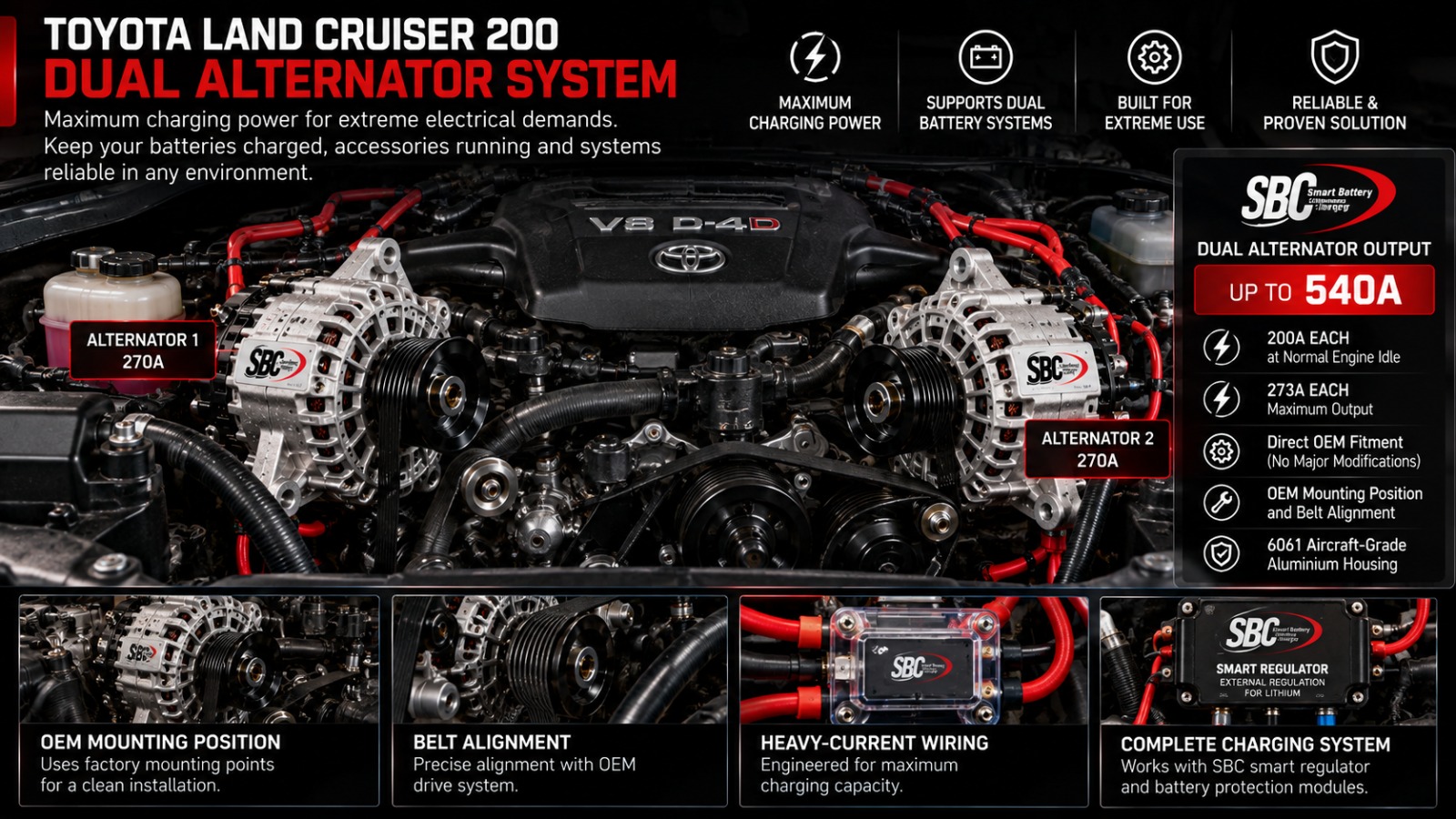
High Output Alternator Idle Amps: Why RPM Matters
High output alternator idle amps describe how much electrical current an alternator can deliver while the engine is idling. The figure is not necessarily the same as the maximum amperage shown in a product name. Alternator output depends on alternator shaft speed, pulley ratio, temperature, electrical load and the design of the specific unit.
This distinction matters in 4x4s, touring vehicles, work vehicles and auxiliary-battery systems. A vehicle may have a high-rated alternator but still experience low charging voltage when the engine is idling with cooling fans, air conditioning, lighting and battery-charging equipment operating together.
The solution is to understand the relationship between engine RPM and alternator RPM, measure the available output under realistic conditions and select an alternator that matches the vehicle’s electrical demand.
Quick answer
A high-output alternator does not necessarily produce its maximum rated current at engine idle. Its actual output depends on alternator speed and operating conditions. To assess idle performance, check the manufacturer’s output curve and test the charging system under a representative electrical load.
1. What Are High Output Alternator Idle Amps?
High output alternator idle amps are the current available from an alternator when the engine is running at idle speed. They help indicate whether the charging system can support the vehicle’s electrical loads during stationary operation or slow driving.
Three different measurements should not be confused:
- Maximum output: the highest rated current under the manufacturer’s specified test conditions.
- Idle output: the current available at a defined engine idle speed and test condition.
- Available spare current: the current remaining after the vehicle’s active electrical loads are supplied.
These figures answer different questions. An alternator could deliver substantial current at idle, but much of that current may already be required by the vehicle’s electrical systems. The current remaining for auxiliary battery charging can therefore be lower than the alternator’s measured output.
For this reason, compare both maximum output and low-speed output when evaluating a high-output alternator. If the vehicle spends long periods idling or crawling off-road, low-speed performance deserves particular attention.
2. Why an Alternator Produces Less Current at Low RPM
An alternator converts mechanical rotation from the engine into electrical power. Its rotor turns inside the alternator, and the generated electrical output depends partly on rotor speed and the alternator’s internal design.
At low engine speed, the alternator pulley generally turns more slowly than it does at cruising speed. If the alternator has not reached the speed required to produce its rated output, it cannot necessarily supply the full current indicated by its maximum rating.
The exact relationship between speed and current is not a simple universal formula. Output also depends on magnetic design, winding characteristics, regulator behaviour, voltage, temperature and the electrical load connected to the alternator.
Why This Matters in Real Vehicles
- At traffic lights: the engine may idle while the air conditioning and electrical accessories remain active.
- During slow off-road driving: engine RPM may remain low even when cooling fans and other equipment are running.
- While stationary: auxiliary batteries may continue drawing charging current if the charging system supports it.
- In hot conditions: operating temperature may affect the alternator’s available output.
A high-output alternator should therefore be evaluated using the operating conditions that matter to the vehicle, not just its maximum current rating.
3. Engine RPM vs Alternator RPM: Understand the Pulley Ratio
Engine RPM and alternator RPM are different measurements. The crankshaft pulley drives the alternator through a belt, and the relative diameters of those pulleys determine the alternator’s approximate rotational speed.
Approximate alternator RPM = Engine RPM × Crank pulley diameter ÷ Alternator pulley diameter
For this calculation, use the effective belt-running diameters of the pulleys. The result is an approximate speed ratio; actual operation can be affected by belt slip and the pulley design.
Example: A 3:1 Pulley Ratio
Consider an illustrative system with a 6-inch crank pulley and a 2-inch alternator pulley.
| Engine Speed | Approximate Pulley Ratio | Calculated Alternator Speed |
|---|---|---|
| 750 RPM | 3:1 | 2,250 RPM |
| 1,000 RPM | 3:1 | 3,000 RPM |
| 1,500 RPM | 3:1 | 4,500 RPM |
These are mathematical examples, not specifications for every vehicle. They show why two vehicles idling at the same engine RPM can have different alternator speeds if their pulley ratios differ.
Pulley selection must remain within the alternator manufacturer’s speed limits and the belt drive’s mechanical constraints. A smaller alternator pulley may increase alternator speed at idle, but it can also increase alternator speed at high engine RPM and affect belt wrap, belt loading and durability.
4. Maximum Amps vs Idle Amps: What Should You Compare?
When comparing high-output alternators, look beyond the largest number in the product title. Check the output information supplied by the manufacturer and confirm the conditions under which those figures were measured.
| Specification | What It Tells You | Why It Matters |
|---|---|---|
| Maximum rated output | Published peak or maximum current under specified conditions. | Helps compare the alternator’s upper output capability. |
| Idle output | Current at a defined low engine or alternator speed. | Useful for stationary operation and slow driving. |
| Output at operating temperature | Performance after the alternator warms up. | Helps assess sustained performance under real conditions. |
| Regulator compatibility | How the alternator controls charging voltage and current. | Important for vehicle electronics and battery charging. |
| Fitment and belt drive | Mounting, pulley and drive-system compatibility. | Determines whether the unit can be installed and operated correctly. |
If the manufacturer publishes an output curve, use it to identify the current available at the relevant alternator speed. Do not assume that a particular percentage of maximum current will always be available at engine idle.
5. How Electrical Loads Affect Available Charging Current
The alternator supplies current to the vehicle’s electrical systems as well as to any connected auxiliary charging equipment. The amount available for battery charging depends on the total demand and the alternator’s actual output at that moment.
Consider this illustrative example:
| Electrical Demand | Example Current |
|---|---|
| Vehicle electronics and ignition | 25A |
| Cooling fans | 35A |
| Blower and other accessories | 20A |
| Total example demand | 80A |
If the alternator produces 100A under those particular conditions, approximately 20A remains before accounting for other loads, charging losses and changes in demand. If its available output falls below 80A, the battery may need to supply some of the difference.
This is a simplified example, not a rating for a specific vehicle. Actual accessory currents vary, and some loads cycle on and off. The principle remains the same: available spare current is the difference between actual alternator output and the electrical demand at that time.
This is why a vehicle may show acceptable charging performance while cruising but struggle to maintain its battery charge during extended idling with several accessories operating.
6. Heat, Cooling and Continuous Low-Speed Operation
Alternators generate heat while producing electrical current. Their operating temperature depends on electrical load, rotational speed, airflow, ambient temperature and construction.
Low-speed driving can create a challenging combination: electrical demand may remain high while alternator speed and cooling airflow are lower than during normal cruising. However, the amount of temperature rise and any reduction in output depend on the specific alternator and installation.
What to Check
- Whether the alternator is rated for the intended continuous electrical load.
- Whether the pulley ratio keeps the alternator within its specified speed range.
- Whether the belt is correctly aligned, tensioned and maintained.
- Whether the alternator has the required airflow and clearance.
- Whether the manufacturer’s guidance specifies temperature limits or output derating.
Do not assume that a high maximum amp rating guarantees the same output indefinitely at low speed and high temperature. For demanding installations, use manufacturer output data and temperature guidance rather than relying on generalised performance claims.
7. How to Diagnose Low Charging Output at Idle
If the battery voltage drops while the engine is idling, test the system before replacing the alternator. Low voltage can result from insufficient alternator output, excessive electrical demand, a weak battery, poor connections or another charging-system fault.
- Inspect the belt drive. Check belt condition, tension, alignment and pulley compatibility. Follow the vehicle and alternator manufacturer’s procedures.
- Check the battery condition. A damaged or inadequately charged battery can affect system behaviour. Test it using an appropriate battery-testing procedure.
- Measure charging voltage. Record the voltage at the battery under consistent conditions, following the vehicle manufacturer’s testing guidance.
- Repeat the measurement at idle and raised RPM. Use safe, manufacturer-approved test speeds and keep the test conditions consistent.
- Repeat with representative electrical loads. Where appropriate, test with accessories switched on to see how the system responds to demand.
- Inspect cables and grounds. Check terminals, the positive charging path and ground connections. Measure voltage drop under load if the appropriate test procedure and equipment are available.
- Compare results with the correct specifications. Use the alternator’s output curve and the vehicle manufacturer’s charging-system guidance to interpret the results.
Voltage alone does not tell you exactly how many amps an alternator is producing. If current output needs to be confirmed, use suitable current-measurement equipment and the correct test procedure.
Can a Higher-Output Alternator Improve Idle Charging?
It can, if the selected alternator is designed to deliver more current at the relevant low speed and the rest of the charging system is compatible. A higher maximum rating by itself does not prove that idle output will be sufficient.
Before choosing an upgrade, compare the manufacturer’s idle or low-speed output data, check the pulley ratio and calculate the vehicle’s actual electrical demand. Also assess the wiring, grounding, regulator compatibility and auxiliary battery charging method.
For vehicle-specific options, explore the Smart Battery Charger alternator range. Confirm the exact engine application, product specifications and fitment before ordering.
EXPLORE HIGH-OUTPUT ALTERNATORS →
Frequently Asked Questions
How many amps should a high-output alternator produce at idle?
There is no single figure that applies to every high-output alternator. Idle output depends on the alternator model, alternator speed, pulley ratio, temperature and test conditions. Check the manufacturer’s low-speed output specifications for the specific unit.
Why does my alternator charge better when driving than at idle?
Driving usually increases engine and alternator speed, which can allow the alternator to produce more current. If electrical demand exceeds available output at idle, the battery may supply the shortfall until output increases or demand falls.
Does a 300A alternator produce 300A at idle?
Not necessarily. A 300A label generally indicates a maximum or rated output under specified conditions. The current available at idle must be confirmed from the manufacturer’s output data.
How do I calculate alternator RPM from engine RPM?
Multiply engine RPM by the effective crank pulley diameter and divide by the effective alternator pulley diameter. For example, a 3:1 ratio at 750 engine RPM gives an approximate alternator speed of 2,250 RPM. This estimate assumes no belt slip.
Can changing the alternator pulley improve idle output?
A smaller alternator pulley can increase alternator speed at a given engine RPM, potentially improving low-speed output. However, pulley changes must remain within the alternator’s maximum speed limits and the belt drive’s mechanical constraints.
Why does my battery lose charge while the engine is running?
The electrical load may exceed the alternator’s available output, especially at low speed. A weak battery, poor connections, belt problems or a charging-system fault can also contribute. Measure the system under consistent conditions before diagnosing the cause.
Is charging voltage enough to measure alternator output?
No. Voltage helps assess charging-system behaviour, but it does not independently establish the alternator’s current output. Current measurement and comparison with the correct output specifications may be necessary for a complete diagnosis.
Conclusion: Select an Alternator for Real Operating Conditions
High output alternator idle amps matter because a vehicle’s electrical demand does not stop when the engine returns to idle. Alternator speed, pulley ratio, temperature and active electrical loads all influence the current available for the vehicle and its auxiliary batteries.
The most reliable selection process is to verify the manufacturer’s low-speed output data, calculate the pulley ratio, measure the vehicle’s electrical demand and test the charging circuit under representative conditions. This approach is more useful than choosing an alternator based only on its maximum amp rating.
To compare potential upgrades, review the Smart Battery Charger alternator range and confirm the model’s fitment and output specifications for your application.