
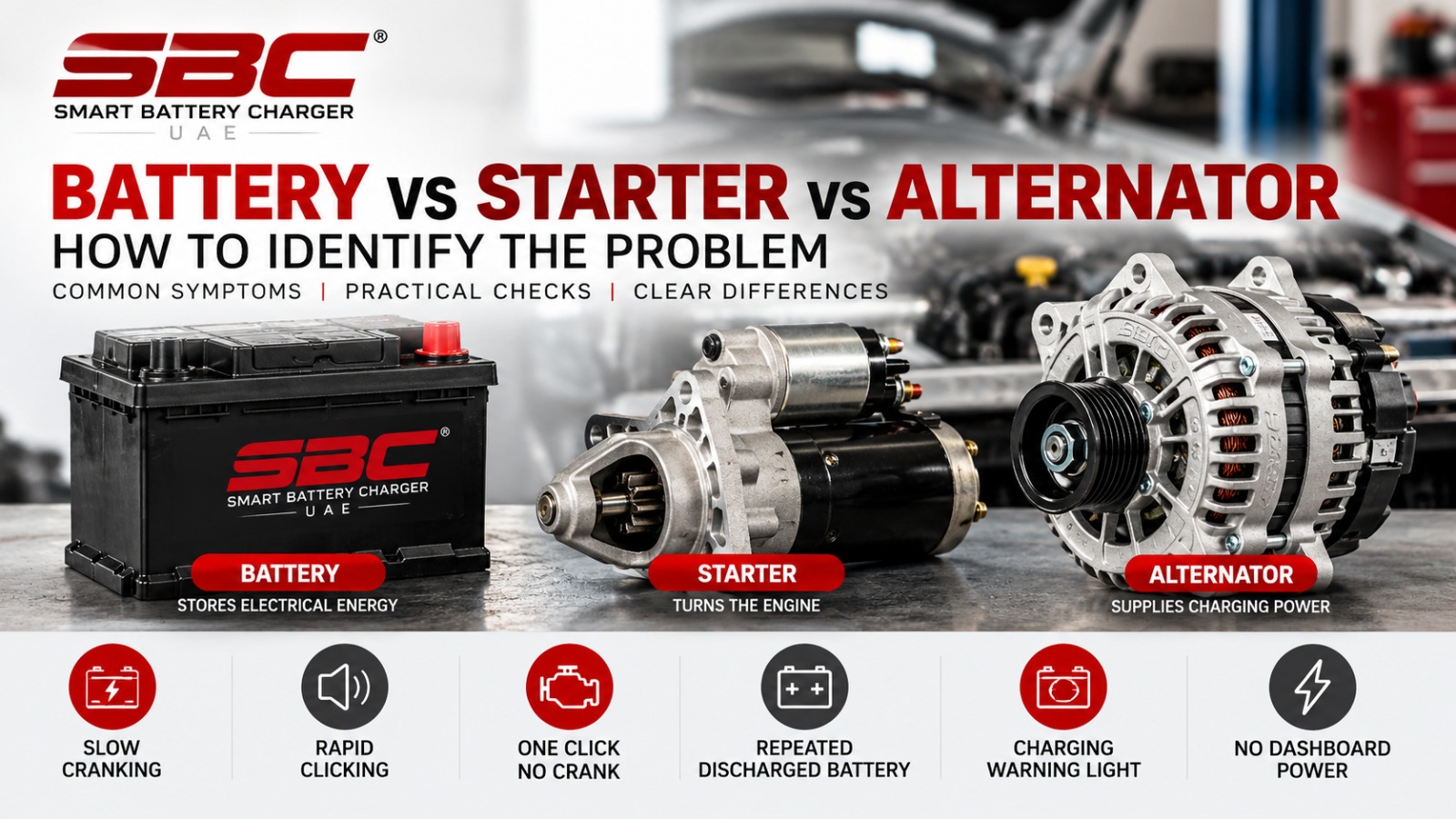
When a vehicle will not start, the battery, starter and alternator are three components worth investigating. They perform different jobs, and replacing the wrong component can waste money without fixing the underlying problem.
Understanding the battery vs starter vs alternator symptoms can help you identify what to check first. The key is to distinguish a battery that cannot supply enough power, a starter that cannot turn the engine, and a charging system that cannot replenish the battery. Symptoms are useful clues, but testing is needed to confirm the cause.
Quick Answer: Which Component May Be Faulty?
- Slow cranking or repeated clicking: Check battery condition, terminals and cables first.
- One click with no engine cranking: Check battery power, connections, starter circuit and solenoid.
- Battery repeatedly goes flat: Test the battery, charging system and possible parasitic drain.
- Charging warning light while driving: Investigate the charging system, wiring, belt and regulator.
These symptoms are not definitive diagnoses. More than one fault can produce similar behaviour.
What the Battery, Starter and Alternator Actually Do
1. Battery: Stores Electrical Energy
The starting battery supplies the high current needed to operate the starter motor. It also powers electrical equipment when the engine is off and helps stabilise the vehicle’s electrical system.
A discharged, deteriorated or damaged battery may not supply enough power to crank the engine. However, a battery can become discharged because of a charging fault, poor connections or an electrical drain, so do not assume it automatically needs replacing.
2. Starter: Turns the Engine
The starter motor uses electrical energy from the battery to rotate the engine during starting. If the battery and connections are serviceable but the engine does not crank correctly, the starter, solenoid or control circuit may need investigation.
A clicking sound does not prove the starter is faulty. Low battery power and excessive resistance in the cables can create similar symptoms.
3. Alternator: Supplies Charging Power
In conventional combustion-engine vehicles, the alternator converts mechanical energy from the running engine into electrical power. It supplies vehicle electrical loads and replenishes the battery under suitable operating conditions.
If the alternator or another part of the charging circuit fails, the battery may gradually lose its charge. A damaged belt, poor connection, wiring fault or regulator problem can also affect charging performance.
Battery vs Starter vs Alternator: Symptoms Compared
| Observed symptom | Possible causes | What to check |
|---|---|---|
| Slow engine cranking | Weak battery, poor connections or starter fault | Battery condition, terminals, cables and starter current draw |
| Rapid clicking | Insufficient electrical power or a connection problem | Battery charge, terminal condition and ground connections |
| One click, no crank | Starter, solenoid, battery or cable fault | Battery test, voltage drop and starter circuit |
| Repeatedly discharged battery | Charging fault, battery deterioration or parasitic drain | Battery health, charging output and key-off current draw |
| Charging warning light while driving | Alternator or charging-system fault | Charging output, belt drive, wiring and regulator |
| No dashboard power | Discharged battery, disconnected terminals or main electrical fault | Battery condition, connections and main power supply |
For additional context on starting faults, read AAA’s overview of common reasons a car will not start.
How to Recognise a Battery Problem
A battery problem is worth investigating when the vehicle cranks slowly, produces repeated clicks or has weak electrical power before starting. Other clues include repeated jump-starts, visibly damaged terminals, corrosion or an unsuccessful battery-health test.
What to check
- Inspect the battery case for visible damage or swelling. Do not handle a damaged battery unnecessarily.
- Check for loose or corroded terminals and damaged cables.
- Test battery state of charge and health using a suitable tester and the manufacturer’s procedure.
- If the battery is discharged, determine why before assuming replacement is required.
A charging fault, parasitic electrical drain, damaged cable or poor ground connection can leave a serviceable battery discharged. Test the system before purchasing a replacement.
How to Recognise a Starter Problem
The starter deserves closer attention when the vehicle has adequate electrical power but the engine does not crank as expected. A single click, intermittent starting or abnormal mechanical noise can indicate a starter or solenoid issue, but battery and cable faults can create similar symptoms.
A qualified technician may verify the starter command, test voltage drop across the positive and ground circuits, and assess starter operation and current draw.
Safety note: Do not repeatedly attempt to crank an engine that produces grinding noises. Arrange a proper inspection to avoid further damage.
How to Recognise an Alternator Problem
An alternator problem often appears as a charging issue rather than an isolated starting failure. The battery may initially start the vehicle but gradually lose charge because the charging system is not replenishing it adequately.
Common warning signs
- The battery or charging warning light stays on while the engine is running.
- Electrical equipment behaves inconsistently or lights flicker.
- The battery repeatedly becomes discharged.
- Unusual belt noise, grinding or an electrical burning smell develops.
These symptoms do not prove the alternator itself has failed. A damaged drive belt, wiring fault, poor connection, regulator issue or another electrical problem can produce similar behaviour.
If the charging warning light remains on while driving, stop somewhere safe and arrange professional assistance. Do not assume the vehicle can continue running normally.
7 Critical Checks Before Replacing Any Component
- Record the symptom. Determine whether the engine does not crank, cranks slowly, starts and stalls, or starts but later loses electrical power.
- Inspect visible connections. Look for loose terminals, corrosion, damaged cables and obvious signs of overheating.
- Test the battery. Check charge and condition with an appropriate tester; recharge and retest when the test procedure requires it.
- Investigate the starter circuit. If the battery is serviceable but cranking is abnormal, check the starter, solenoid, control circuit and cable voltage drop.
- Test charging performance. Follow the vehicle manufacturer’s procedure and account for electronically controlled charging systems.
- Investigate repeated discharge. If the battery continues to go flat, check charging, wiring and possible parasitic current draw.
- Confirm the fault before buying. Use test results and vehicle-specific information rather than replacing components based on one symptom.
For general inspection principles, consult the Bosch Charging Systems technical reference. Use the vehicle manufacturer’s specifications for the actual diagnostic procedure.
When Professional Diagnosis Is Needed
Professional testing is recommended when the vehicle repeatedly fails to start, the charging warning light remains illuminated, the engine stalls, cables become hot or the battery shows physical damage. Modern vehicles may use battery sensors, electronically controlled charging and model-specific starting circuits.
If you are planning a high-output alternator installation, the entire charging circuit matters. Confirm vehicle fitment, regulation requirements and whether the positive and ground cables are suitable for the intended system.
Review Smart Battery Charger UAE’s technical support resources and browse the SBC product catalogue when researching alternator options. Confirm product compatibility with the exact vehicle application before ordering.
Frequently Asked Questions
How can I tell whether my battery or alternator is bad?
A weak battery may cause slow cranking, while a charging-system fault may cause repeated discharge. Test both systems and inspect their connections before replacing either component.
Can a bad alternator cause a good battery to go flat?
Yes. A charging fault can leave the battery undercharged. A parasitic drain, wiring problem or deteriorated battery can also cause discharge.
Does one click mean the starter is faulty?
No. Low battery power, poor cable connections, a starter solenoid fault or a starter problem can produce a click. Testing is needed to distinguish them.
If my car starts with a jump, is the battery definitely bad?
No. A jump-start provides additional electrical power, but the underlying cause could be a discharged battery, charging fault, poor connection or another issue.
Can I drive with the battery warning light on?
A charging fault can lead to loss of electrical power or stalling. Stop safely and arrange professional assistance rather than assuming the vehicle can continue operating normally.
Does a new battery rule out alternator problems?
No. A new battery can still discharge if the charging system, wiring or another part of the electrical system is faulty.
What voltage should a car battery show?
Expected readings depend on battery chemistry, state of charge, temperature and charging strategy. Follow the battery and vehicle manufacturer’s test procedure instead of relying on one universal reading.
Can loose ground cables cause starting problems?
Yes. Poor ground connections can restrict current flow and imitate a weak battery or faulty starter.
Can a high-output alternator fix repeated starting problems?
Not automatically. It will not repair a faulty starter, damaged battery, poor connection or unrelated wiring problem. Diagnose the underlying fault before upgrading.
What should be tested before replacing an alternator?
Check battery condition, charging output, wiring, ground connections, belt drive and regulator operation using the vehicle manufacturer’s procedure.
Researching a High-Output Alternator?
Confirm that the starting and charging systems are working as intended before selecting an upgrade. Check the exact vehicle application, regulation requirements and cable capacity.
Explore SBC alternator products or visit SBC Support for technical resources before making a purchase decision.